

Fifteen years after the Great Recession, the production of new condominiums in Wisconsin’s largest cities remains at low levels. Yet demographic trends point toward new market opportunities for condos. Increased condo supply also could improve housing affordability, but key hurdles may be constraining production — raising the question of whether state and local policy changes might help.
Condominiums play a distinct role in a varied and healthy housing market. Much has been said and reported about Wisconsin’s dearth of condo production since the Great Recession, with developers and builders citing financing and liability hurdles that they say are holding it back.
So it was notable this summer when a local developer unveiled plans to build a 25-story, 226-unit condo tower on Kilbourn Avenue in the heart of downtown Milwaukee. Another developer announced plans shortly afterward for an 89-unit condo project in St. Francis. If constructed, these projects would stand out amid a recent extended period of diminished condo production in Wisconsin.
Our analysis of data from municipal assessment records demonstrates the extent to which, in recent years, Wisconsin’s condo production has lagged. These “condo production” figures include both newly constructed condo units and those converted from other prior uses.
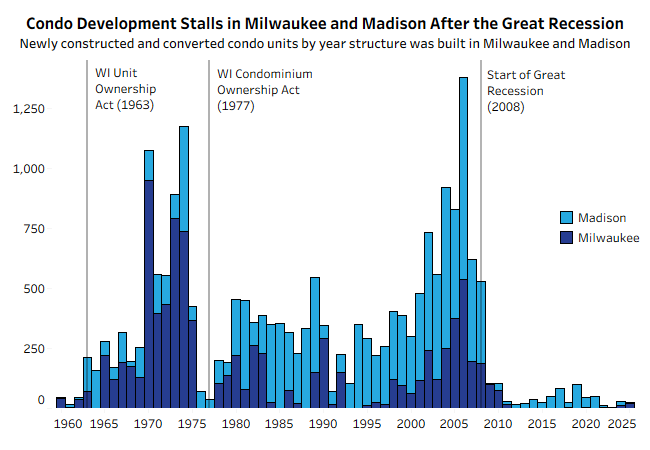
As shown in Figure 1, our state’s two largest cities, Milwaukee and Madison, followed a national pattern in which condo production soared during the 2000s, then plummeted during the Great Recession and immediately afterward. By 2025, in both cities it remained very far below pre-Great Recession levels.
In Madison, condo production ticked up slightly in the late 2010s, but has since declined again to near-zero levels. In Milwaukee, meanwhile, condo production nearly flatlined after the Great Recession.
To give a sense of the scale of the shift, an average of about eight condo units were added in Milwaukee annually during the five-year period from 2021 to 2025, and an average of about 16 units were added annually in Madison. That’s compared to an average of about 309 units annually in Milwaukee and about 547 units annually in Madison during the five-year period from 2004 through 2008, the height of the pre-Great Recession condo-building boom.
For context, our analysis also looks at condo production in the city of Chicago, where condo production occurs on a much larger scale. Chicago produced an average of about 971 condo units annually from 2021 to 2025, compared to an average of about 7,102 annually from 2004 to 2008.
Comparing condos in Wisconsin, nationally
The term “condo” is generally used to describe a housing unit located within a larger building or complex, in which such units are owned separately. Typically, though not always, condo units are owner-occupied. The larger building or complex often includes shared or common spaces. While this describes its colloquial use, in purely legal terms, “condo” refers to the ownership structure of the housing unit.
Wisconsin’s first condominium law was enacted in 1963 and expanded considerably in 1977. Under state statute, condominium units are governed by an association overseen by a board of directors, comprised of the owners of the condo units in a respective building or complex. Owners typically pay monthly fees to the association for expenses including maintenance of the condo building’s exterior, common spaces, and more.
In many markets, the median price for condos is cheaper than for single-family homes, offering prospective buyers a more affordable alternative for homeownership. The increasing cost of homeownership for many Wisconsinites, the focus of past Forum research, has made this point even more salient.
In addition, because condos are often smaller and require less maintenance than single-family homes, they can be attractive to older buyers. As growing numbers of Wisconsinites reach retirement age, some may be ready to downsize out of a single-family home, which would in turn make that larger structure available for a younger family. The availability of condos in our state could determine whether and where this occurs.
Data from the U.S. Census Bureau’s American Community Survey show the change over time, in Wisconsin and nationally, in total owner-occupied housing units located in structures of five or more units. Since the vast majority of these units are condos, they serve as a useful metric to analyze production at a statewide level. Some condos are excluded from these data, including those in structures of less than five units.
They show that from 2010 to 2024, the total number of owner-occupied multifamily units in structures of at least five units increased more on a percentage basis in Wisconsin (+40.2%) than nationally (+27.1%). That’s compared to an increase in the number of rental units in structures of five or more units during the same period: 32.4% in Wisconsin and 28.9% nationally.
Despite this, Wisconsin’s condo stock remains relatively small as a share of all multifamily housing units. Owner-occupied units comprise a much smaller share of all existing multifamily units (both owner- and renter-occupied) in Wisconsin than nationally. The share of Wisconsin multifamily units in structures of five or more units that were owner-occupied was 7.7% in 2024, compared to 12.2% nationally.
As noted previously, these figures include both newly built and newly converted condos. In lieu of publicly available data for condo construction at the state level in Wisconsin, we look to regional and national data on new residential construction from the U.S. Census Bureau and the Department of Housing and Urban Development. As illustrated in Figure 2, it shows that condo building starts as a share of total multifamily housing starts soared nationally during the pre-Great Recession years, then plummeted and largely have not recovered since.
At their 2006 peak, condos accounted for more than half of multifamily housing starts in the Midwestern states, and nearly 45% nationally. By 2025, that share declined to 1.5% in the Midwest and 5.8% nationally.
Where are Wisconsin’s condos?
U.S. Census Bureau data from the American Community Survey also supply county-level estimates for owner-occupied multifamily units in structures of five or more units. These indicate that about two-thirds of such units in Wisconsin are located in its three most populous counties.
An estimated 31% of these units are located in Milwaukee County, while 24% are in Dane County. Waukesha County accounts for about 11% of the total. The other counties with the next largest numbers of such units are Racine, Washington, and Kenosha counties, respectively.
Data from the city of Milwaukee assessor’s office provides an inventory of existing condo units by type, as well as the year the structure was built, dating back to 1854. The following categories are included for condos: those in a high-rise building of 13 or more stories, a mid-rise building of between four and 12 stories, a low-rise building of between one and three stories, a townhouse, or in a duplex or ranch-style home.
These data show that nearly 4,400 condos have been added in the city of Milwaukee in structures built in the last 50 years. Among those, 34.3% were condos in mid-rise structures, 24.5% were in low rise structures, 20.2% were townhomes, and 16.6% were in high rise structures. The remaining 4.3% were either ranch or duplex condos.
Figure 3 shows the time periods in which the structures housing different condo types were produced in Milwaukee. Townhomes and low-rise condos boomed during the 1970s, for example. Mid-rise and high-rise condos have become more prevalent over time, with the former seeing a particularly pronounced building boom in the early 2000s.
More small Households, Fewer condos
More than 52,000 Wisconsinites, or roughly 0.9% of our state’s population, lived in owner-occupied housing units in structures of five units or more in 2024, according to U.S. Census Bureau estimates. That’s compared to the national share of 1.6%.
However, some demographic trends suggest the market for condos in our state has the potential to grow. The typical condo owner lives in a smaller household than the typical single-family home owner. As of 2024, Wisconsin had a greater concentration of households consisting of one or two people (69.4%) compared to the nation (63.0%), Census data show. Growth in such small households also has increased more rapidly in Wisconsin than nationally.
These small households also occupy a greater share of all multifamily housing units in our state than they do nationally. Among multifamily housing units in Wisconsin in structures of five units or more, in 2024, 88.8% were occupied by households of one or two persons. That’s compared to 80.6% nationally.
Yet relative to the nation, Wisconsin has a smaller share of one- and two-person households who currently live in owner-occupied housing units in structures of five units or more. As shown in Figure 4, that share is 1.8% in Wisconsin, compared to 3.1% nationally. This may be in part because condos are most commonly located in urban and large metropolitan areas, and Wisconsin’s population is less urbanized than the nation.
Why more Aren’t being built
Several factors, including financing and liability hurdles, have been cited in our state and nationally as potentially suppressing or delaying the construction of new condo units. Experts with whom we spoke highlighted these issues, as well as the impact of increasing construction costs and mortgage rates. Some of these factors appear to be particularly limiting for smaller-scale condo projects.
At the state level, one of the key policy factors is construction defect liability, or the laws that govern the liability incurred if a homebuyer takes legal action for an alleged defect in the construction of a building, including a condo unit. Developers, builders, architects, and others indicate that the threat of defect lawsuits has had a chilling effect on condo production.
In response, some states have sought to overhaul their defect liability laws in recent years. Some have shortened the period during which homeowners can bring legal action in connection with an alleged construction defect. Notably, Wisconsin changed its laws in 2018 to shorten the period during which legal action could be taken for construction defects, from 10 to seven years after construction.
CONCLUSION
Our research shows that in Wisconsin, the perception of a dramatic slowdown in condo production is rooted in reality.
If policymakers wish to take further action in Wisconsin to encourage condo production, one option would be to again look at state laws governing construction defect liability. Such laws could be further modified to reduce potential liability for builders, developers, architects, and other stakeholders. On the one hand, this would limit the options and legal rights of condo owners, an important consideration. On the other hand, it might enable more Wisconsinites to become condo owners.
Another approach would be to focus on condo financing. One such option would be to allocate state or local dollars to support the conversion of existing multifamily housing units into condos. A bill introduced by state lawmakers in 2025 would create a $10 million state revolving loan fund for this purpose. The fund would provide grants to owners of multifamily housing units to undertake such conversions. This would help to meet the potential demand for condos but would not necessarily add housing overall.
An approach adopted in Massachusetts uses state funds to help finance the construction of condos and single-family homes for homebuyers in historically underserved communities. Last year, the state’s housing finance agency, MassHousing, announced that its CommonWealth Builder program was providing funding for at least two condo projects that would produce units for first-time, moderate-income homebuyers. However, some policymakers may balk at using public funds to subsidize condo construction for middle-income buyers.
Viewed in the context of the broader housing market, condos are a relatively small component in Wisconsin and nationally. In many places in Wisconsin, especially in rural areas and small towns, there may not be a condo for many miles in any direction.
But especially in urban and some suburban areas, condos offer buyers a potential alternative to single-family homes – and in many cases, a more affordable entry point into ownership. And for our state’s aging residents, condos may offer a particularly appealing mix of location, amenities, smaller size, and limited maintenance.
These and other factors suggest that policymakers may wish to consider any additional steps that may be warranted to ensure developers and builders can meet market demand for condos. Doing so could offer Wisconsinites more variety, affordability, and suitability in their housing options.